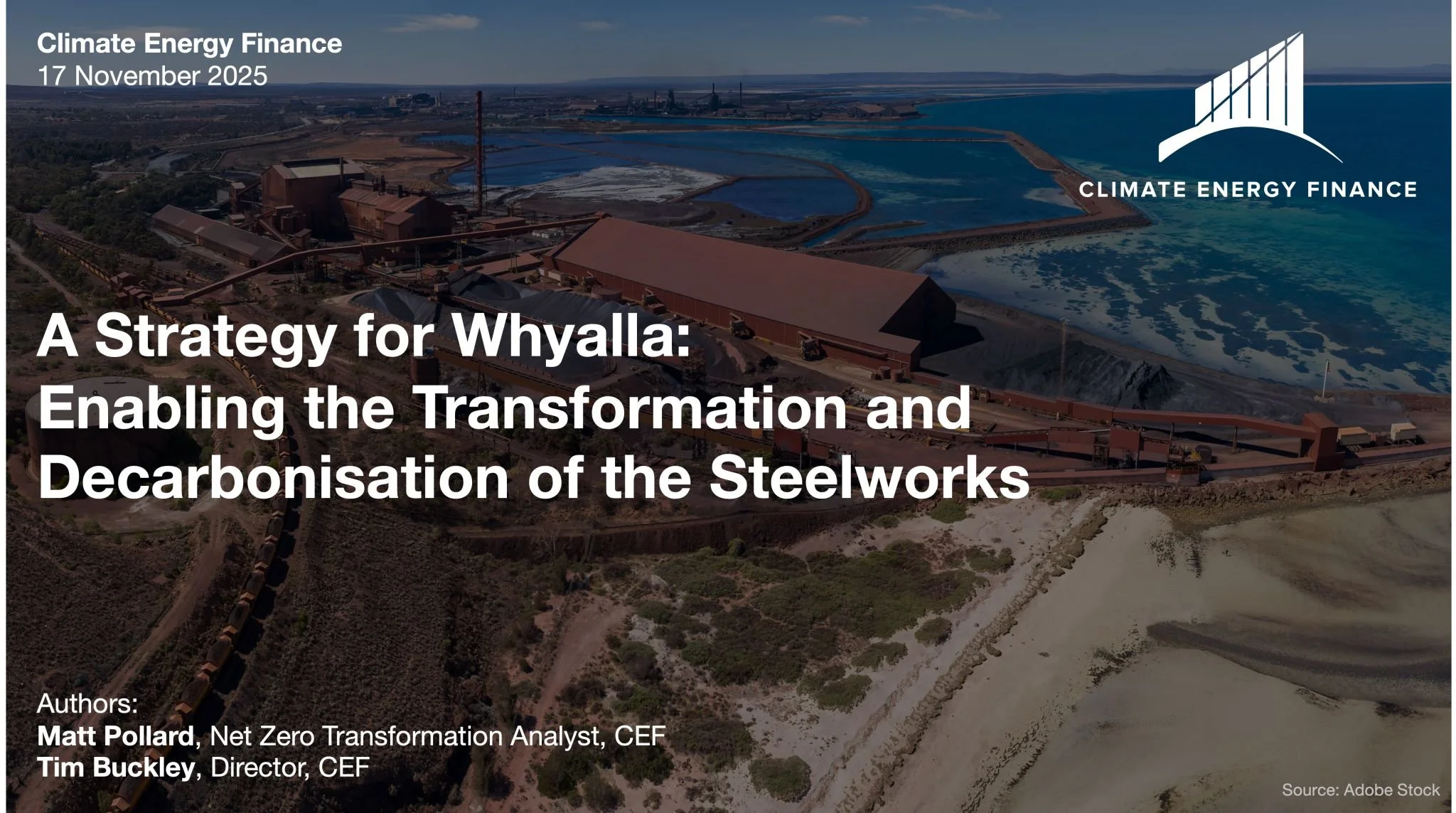
A Strategy for Whyalla:Enabling the Transformation and Decarbonisation of the Steelworks
Leveraging targeted industry and climate policy to support a first-of-a-kind capital deployment into green iron production in the Australian context.
Report Summary (p. 4)
As South Australia (SA) sets a pathway forward to revitalise the Whyalla Steelworks, it must remain steadfast in its ambition to leverage its leadership in renewables and comparative advantage in new energy trade to deploy capital at speed and scale into firmed renewable energy supply and build a first-of-a-kind (FOAK) green iron hub in the southern hemisphere.
The SA Government must reevaluate the cost and risk of locking-in a fossil gas ‘transition’ of Whyalla. Gas is not the solution for Whyalla, in the interim and in the long-term. Domestic gas prices in Australia make it uneconomic, and incompatible with Australia’s decarbonisation and climate ambitions. CEF’s analysis shows that public capital expenditure of $1.7-2bn over a decade in gas supply subsidies and hundreds of millions in gas pipeline infrastructure spending would be required to just halve the competitive gap in pricing between SA and other direct reduced iron (DRI)-producing nations in North America and the Middle East where gas prices are a fraction of east Australia’s.
Gas giant Santos has long been a gas supplier to the Whyalla Steelworks and would continue to be in a gas-led ‘transition’. Billions in public capital towards a methane gas ‘transition’ of the Steelworks is a taxpayer subsidy to Santos that Australia can ill-afford. Australia does not have a gas shortage problem; more supply is not the solution. It has a gas export and price distortion problem, driven by Santos’ large-scale siphoning of domestic supply into export markets.
To provide strategic, targeted public, national interest support for a FOAK capital deployment in clean commodity production, CEF recommends SA Government adopt a Long-term Energy Service Agreement (LTESA) / Scheme Finance Vehicle (SFV)-style government underwriting mechanism to unbundle project-on-project risk (the stacking of risk from mutually dependent projects). This is critical to lowering the cost of capital for the firmed renewables required to establish a green DRI facility, improving the bankability of a green transformation for Whyalla.
Absent a price on carbon, SA must champion the development of bilateral partnerships with key offtake markets to bridge the commercial gap between fossil fuel- and renewables-powered production, and catalyse green iron and steel trade corridors, between Australia, Japan, Korea and China. CEF sees a critical gap in strategic public support for clean commodity market-forming mechanisms to complement supply-side production-based credits and capital grants. This includes a Clean Commodities Trading Initiative (CCTI) providing a long-term price guarantee for Whyalla’s new owners to commit to the major capital investments required to transition to a DRI facility and enable decarbonisation of the process.
SA must also focus on the broader SA green iron opportunity, with Whyalla as a lighthouse green iron project. The stalled progression of green iron in the broader SA context has been further exacerbated by the lack of clarity over policy direction. CEF urges the SA Government to publish the outcomes and recommendations of the Green Iron Opportunity Expression of Interest consultation process launched in June 2024 to provide clarity and direction to industry.
Scaling a green iron industry requires the SA Government to enable the expansion of the state’s magnetite industry through common-user and strategic public-private infrastructure. In addition to generating significant spillover benefits for the Eyre Peninsula, unlocking SA’s current investment pipeline of magnetite deposits could grow magnetite production to 29Mtpa, conservatively generating $6bn in export revenues and over $300m in royalties annually to the SA budget.